




Adults often think of networking as something that begins later in life. It belongs to conferences, careers, business development, job searches, and professional introductions. Children, on the other hand, simply make friends. Yet the difference may be smaller than it appears.
Long before anyone exchanges a business card, children are already learning many of the skills that shape their relationships as adults. They learn how to approach someone they do not know, remember names, join an existing group, recognise whether a friendship feels healthy, include someone who is standing alone, and decide when they need to find a different circle. These are not business skills. They are human skills.
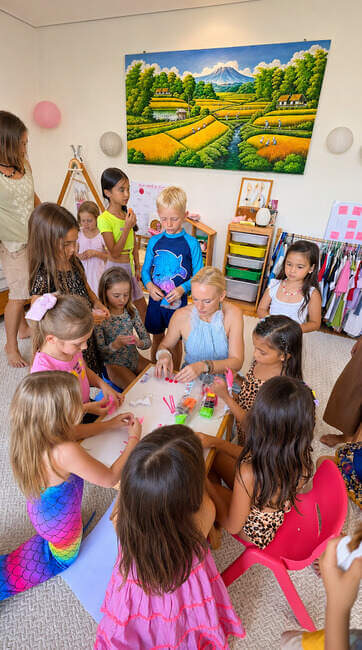
One podcast conversation describes teaching children networking not through professional language, but through “making friends and changing friends and sharing with friends.” That framing is especially relevant in Bali, where many children grow up in unusually international environments. Classmates may arrive from different countries, speak different languages at home, stay for different lengths of time, and move between schools or communities more frequently than in less transient places.
For some children, this creates extraordinary exposure. They learn early that people can eat different food, celebrate different holidays, speak differently, or have families that look different from their own. But international diversity does not automatically create social confidence. A classroom can contain children from ten countries while one new student still eats lunch alone.
The smallest act of connection can change that experience. One particularly simple lesson from the podcast is what to do when a new child arrives: “Walk up and say, ‘Hey, welcome to the school.’” For an adult, those words may seem almost too simple to matter, but for a child arriving in a new country or school, they can mean everything.
Being the new person requires constant interpretation. Where do people sit? Who already knows one another? What are the rules nobody explained? Is it okay to join this game? Will someone understand my accent? Who should I ask if I need help? One child choosing to walk over can remove some of that uncertainty.
This is leadership in one of its earliest forms. It is not leadership as authority, but leadership as noticing. The ability to recognise that someone is standing outside the group and take the first step toward them is something many adults still struggle to do.
Article 1 of this series explored the hesitation adults can feel before approaching someone new. The internal conversation often continues long after childhood: What if they do not want to speak to me? What if I say the wrong thing? Do I belong here? Children experience versions of the same uncertainty, which is why childhood can be a useful time to normalise small acts of social courage.
Remembering names is another example. The podcast conversation makes a useful point: “If you meet someone and you don’t remember their name, it’s okay to ask them for their name again. Don’t be shy.” Adults often pretend they remember and spend an entire conversation avoiding the person’s name because admitting they forgot feels embarrassing. Children can be taught something simpler: forgetting is normal, and asking again shows that remembering matters.
The lesson extends beyond names. Children will misunderstand one another, friendships will change, someone will feel excluded, and groups will form and reform. Adults often want to protect children from these experiences, but relationships inevitably involve change. Learning how to navigate that change may be as important as learning how to make the friendship in the first place.
The podcast conversation reflects on this directly, noting that children can be encouraged to have diversity in their friendships and understand that if certain friendships no longer make them feel good, it is acceptable to meet other people without needing to turn the old friendship into an enemy. This is a surprisingly mature idea because children often receive two messages at once: be loyal to your friends, but also choose good friends.
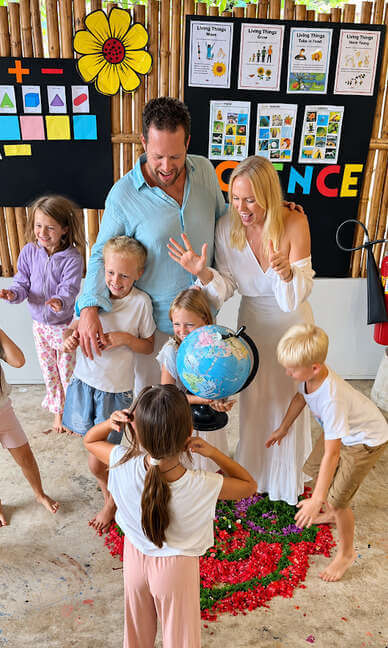
Both can be true. A relationship can matter deeply during one period of life and change later. Children move classes, interests change, families relocate, personalities develop, and new friendships become important. Learning that relationships can evolve without becoming dramatic failures may help children develop healthier social expectations as adults.
Bali makes this especially visible because international communities often experience frequent arrival and departure. A close friend may move countries at the end of the school year, while another child joins halfway through the term. Families may travel for several months and return. Children can experience repeated cycles of connection, separation, and reconnection long before adulthood.
These experiences can be difficult, but they can also teach adaptability. The goal should not be to make children endlessly social. Some children naturally enjoy large groups, while others prefer one close friend. Some walk into new environments confidently, while others observe for a long time before deciding whom to approach.
The podcast makes an important distinction around introversion, describing introverts as highly sensitive to their surroundings and suggesting that what appears to be shyness can sometimes be observation. This matters because encouraging connection should not mean forcing children to become extroverts.

Social confidence does not require being the loudest person in the room. A quiet child can still welcome someone new. An introverted child can remember a name. Someone who prefers small groups can still learn how to introduce themselves or ask another person to join. The skill is not constant talking. It is knowing that connection is possible when it matters.
Parents and schools can support this through ordinary moments rather than formal networking lessons. When a new family joins a class, children can be encouraged to introduce themselves. When someone forgets a name, adults can model asking again without embarrassment. When friendships change, the conversation can focus less on blame and more on what each child is learning about the relationships they need.
Children can also be taught to notice who is not included. This may be one of the most important lessons of all. Many social environments reward the ability to enter a group, but far less attention is given to the ability to open the group for someone else.
A child who learns to notice the person standing alone may grow into an adult who does the same at a meeting, workplace, neighbourhood gathering, dinner, or event. That is where childhood social skills become community skills.
Bali’s international environment gives families a powerful opportunity to practise this because difference is already present. The challenge is to move from simply being surrounded by diversity to actively engaging with it.
Children will eventually enter a world where technology can introduce them to almost anyone. They may have access to networks larger than any previous generation. But access will not automatically teach them how to make someone feel welcome. That remains deeply human.
Perhaps networking was never something that began in business after all. Perhaps it began the first time we noticed somebody new and decided to walk over.
What would change if children learned early that making someone feel welcome is a form of leadership?