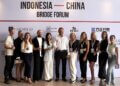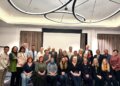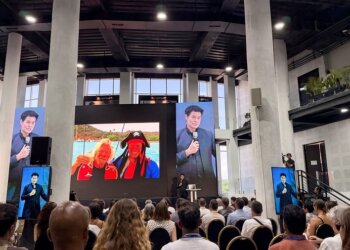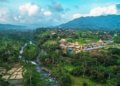




Some ideas arrive quietly and stay with you for weeks. Last week, inside the Labyrinth Convention Center at Nuanu Creative City, I listened to a theoretical physicist, a serial entrepreneur and two of the developers building on Bali’s west coast describe the same future from four different angles. I went as the guest of Dmitrii Chernyshev, Commercial Director at Bali Baza Development, expecting a conference. I left with a sharper sense of where this island, and the way we buy property on it, is heading.
The Genius Future Summit ran over two days on 5 and 6 November, hosted by Genius Group on the site of its planned Genius City. The ambition is not small. Nuanu covers 44 hectares, and Genius Group holds a majority stake in a learning and living district there, with its Learning, Living and Student Hubs scheduled to open in late 2027. The company’s founder, Roger James Hamilton, describes it as a city designed around education rather than one that bolts a school on at the end.
The Second Half of the Chessboard
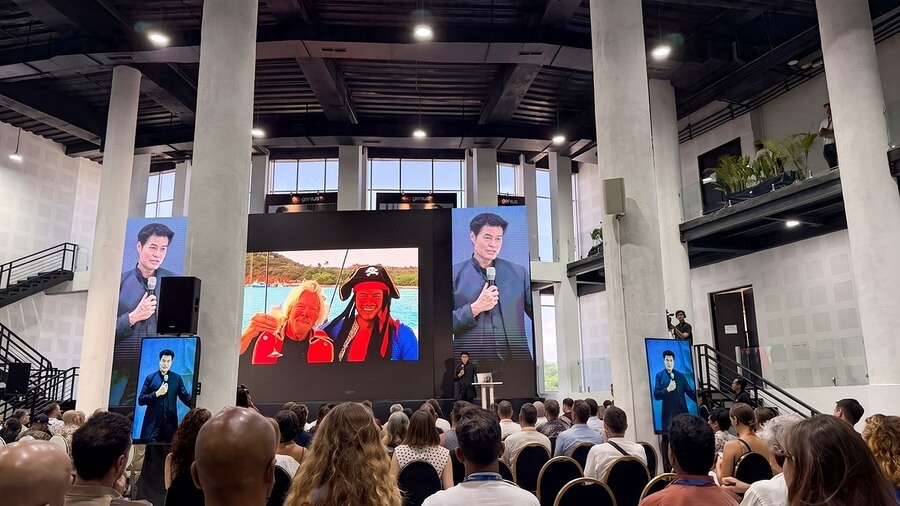
Roger opened with an old story. An inventor presents a chessboard to an emperor and asks for one grain of rice on the first square, two on the second, four on the third, doubling all the way to the sixty fourth. The emperor agrees, then discovers that the second half of the board demands more rice than the world has ever grown.

His point was about computing power. If you start counting from around 1958, when information technology began to be tracked as a category of investment, and double roughly every 18 months, the second half of the chessboard begins around 2006. Since then we have had the smartphone, cars that drive themselves and machines that beat world champions at games of judgement. His conclusion was simple and slightly unnerving: if we have only just entered the second half, we have not seen anything yet.
What stayed with me more was a smaller observation. We can now locate any person on earth to within a metre using satellites in space, he said, yet most people have no equivalent tool to find their way to their own purpose. Technology, in his framing, should be judged by whether it helps people get there. It is a generous way to think about progress, and the energy in that room reflected it.
A Physicist’s View of Which Work Survives
Dr Michio Kaku, the theoretical physicist and futurist, was in Bali for the first time. He placed humanity at roughly 0.7 on the scale physicists use to rank civilisations by the energy they command, close to the point where a civilisation becomes truly planetary and shares its technology rather than fighting over it. He was candid about the timeline on quantum computing, which he expects to arrive within years rather than decades, and about its darker side: a machine powerful enough to break today’s digital encryption will interest every government on earth.
His most useful remarks, for anyone in property, concerned work. Robots, he argued, will take the jobs that are repetitive. They will struggle with the jobs that are not. A carpenter, a plumber or a gardener faces a different problem every day, because every nail is different and every piece of lumber is different. Creative work, judgement and understanding human behaviour fall in the same protected category.
He closed on a note that suited the setting. Science, he said, cuts both ways. Technology is neither good nor evil; what matters is who masters it and what they choose to do with it.
Building the Future, One Structure at a Time
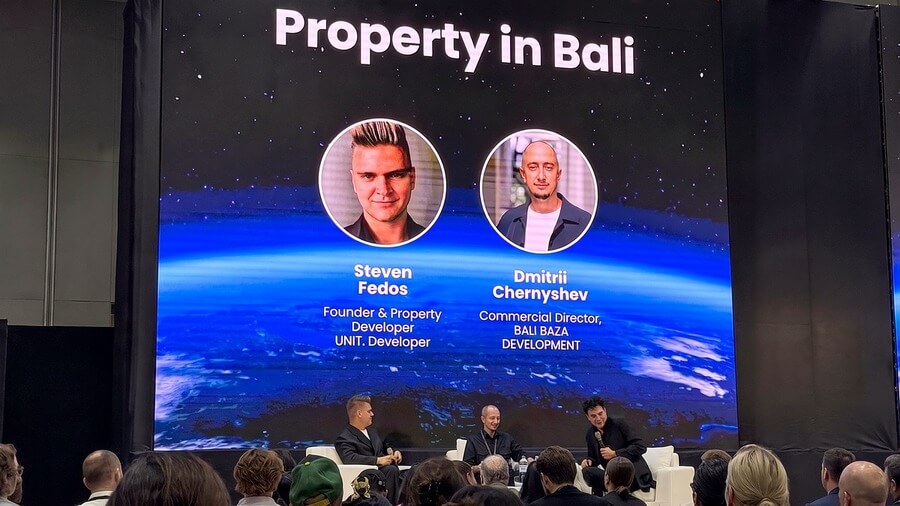
That question of mastery became practical when Dmitrii shared the stage with Steven Fedos, founder and CEO of UNIT. Dmitrii first came to Bali a decade ago and moved his company here five years later. Bali Baza’s latest work, Origins, is a collection of 18 signature villas inside Nuanu itself.
Steven described an approach to construction built on technology and new methods, which grew out of prefabricated building. UNIT has now completed more than 100 homes, with more than 200 more scheduled over the coming years. His argument was not that technology makes a house cheaper on day one. The starting cost, he said, is broadly the same as traditional construction. The saving comes later, through fewer mistakes, less overspending and lower management overheads. Anyone who has watched a Bali build drift past its budget will recognise the problem he is solving.
UNIT’s flagship project with Nuanu Real Estate, Black Sands Oasis, puts that thinking on paper. It comprises 111 homes, offered on a lease of 35 years with an option to extend for a further 20, and carries a structural warranty of 25 years. Steven has described calling it a flagship as a commitment to stand behind everything from the structure itself to how the property is managed after handover.
Both men were frank about the pressure on the industry. Construction costs on the island are rising, and regulation now makes it far harder to simply arrive, build and rent out. For transparency, Fullers works with Bali Baza as an approved agency partner on a separate project, and we take no commission on either project named here.
What Does Not Change for Buyers
Here is where Dr Kaku’s nail becomes useful. Technology will change how Bali builds. It will change how buyers search, compare and pay. Some of what was discussed at the summit, from tokenised communities to AI in every classroom, will reshape how people live here within the decade.
What it will not do is make Bali property repetitive. No two land titles here are identical. No two leases carry the same extension terms, and no two building permits tell the same story. A warranty of 25 years is only as strong as the entity standing behind it in year 20. A lease extension option is only as reliable as the clause that defines who carries it. However a property is designed, built, packaged or paid for, the land rights underneath are still governed by Indonesian law and still need to be checked at source.
That work sits firmly in the category Dr Kaku called safe. It requires judgement, local knowledge and an understanding of how people behave when money and promises are on the table. AI can help a buyer read a contract faster. It cannot stand on the land, sit across from a notary or tell a buyer, honestly, that this is not the one.
I left Nuanu genuinely inspired. Roger’s insistence that the future should lift as many people as possible is the right instinct for an island that has always attracted dreamers. The developers who will thrive in the second half of the chessboard are the ones who pair that vision with structures buyers can verify.
Architects of the Future
Roger often borrows a line from Buckminster Fuller: we are called to be architects of the future, not its victims. For buyers, that means using every new tool available while keeping the oldest discipline in property intact. Verify the land, the licence and the lease before you commit to the vision.
At Fullers Properties, our CLEAR Buyer Method exists for exactly that balance. Calibrate what you want, Locate the right verified properties, Examine every document at source, Acquire on protected terms and Root the investment for the long term. Buying in Bali should feel exciting, not uncertain.