




It is becoming possible to live an increasingly efficient life without speaking to many people.
A question can be answered instantly by artificial intelligence. Food can be ordered through an app. Meetings can happen through screens. Work can be completed remotely. Travel can be planned digitally, entertainment can be personalised automatically, and professional advice that once required several conversations can sometimes be accessed within seconds.
For many people living and working in Bali, these tools have created extraordinary freedom. Remote professionals can operate global businesses from the island. Founders can manage international teams. Creatives can work with clients in several countries without leaving home.
Technology has removed many barriers.
But it raises another question: what happens to the human interactions that those barriers once required?
One reflection captures the tension clearly: “I recognise that AI will be a challenge for human connection. For some people who allow it to be, I don’t.”

The distinction is important.
Artificial intelligence does not automatically weaken relationships. Like most technology, its influence depends partly on how it is used.
It can replace interaction.
Or it can create more space for it.
Consider something as ordinary as remembering to reconnect with someone. A person may have met hundreds of people through work, events, travel, school communities, or social gatherings. Remembering every birthday, project, conversation, family detail, or promised follow-up becomes difficult.
Technology can help organise that information.
The question is what happens next.
If the tool sends generic messages automatically and the person never becomes involved, efficiency has replaced connection.
If it reminds someone that a friend launched a business three months ago and prompts them to send a personal message, technology has supported connection.
The difference is subtle but significant.
The same principle applies to events. Technology can recommend who someone should meet based on shared interests, industries, or goals. That may make networking more efficient. But an algorithm cannot guarantee that the two people will trust one another, enjoy the conversation, or feel understood.
The introduction can be automated.
The relationship cannot.
This may become one of Bali’s advantages in an increasingly digital world.
People often come to the island because they want experiences that feel tangible. They want to sit with others over food, participate in gatherings, spend time outside, experience culture, join communities, work beside other people, or simply slow down enough to notice where they are.
These experiences become more valuable as everyday life becomes more mediated through screens.
A video call can connect two people across continents, but it does not recreate sharing a table.
A digital community can introduce hundreds of people, but it does not necessarily create the feeling of walking into a place where someone recognises you.
An AI tool can generate excellent questions, but it cannot decide whether another person genuinely cares about the answer.
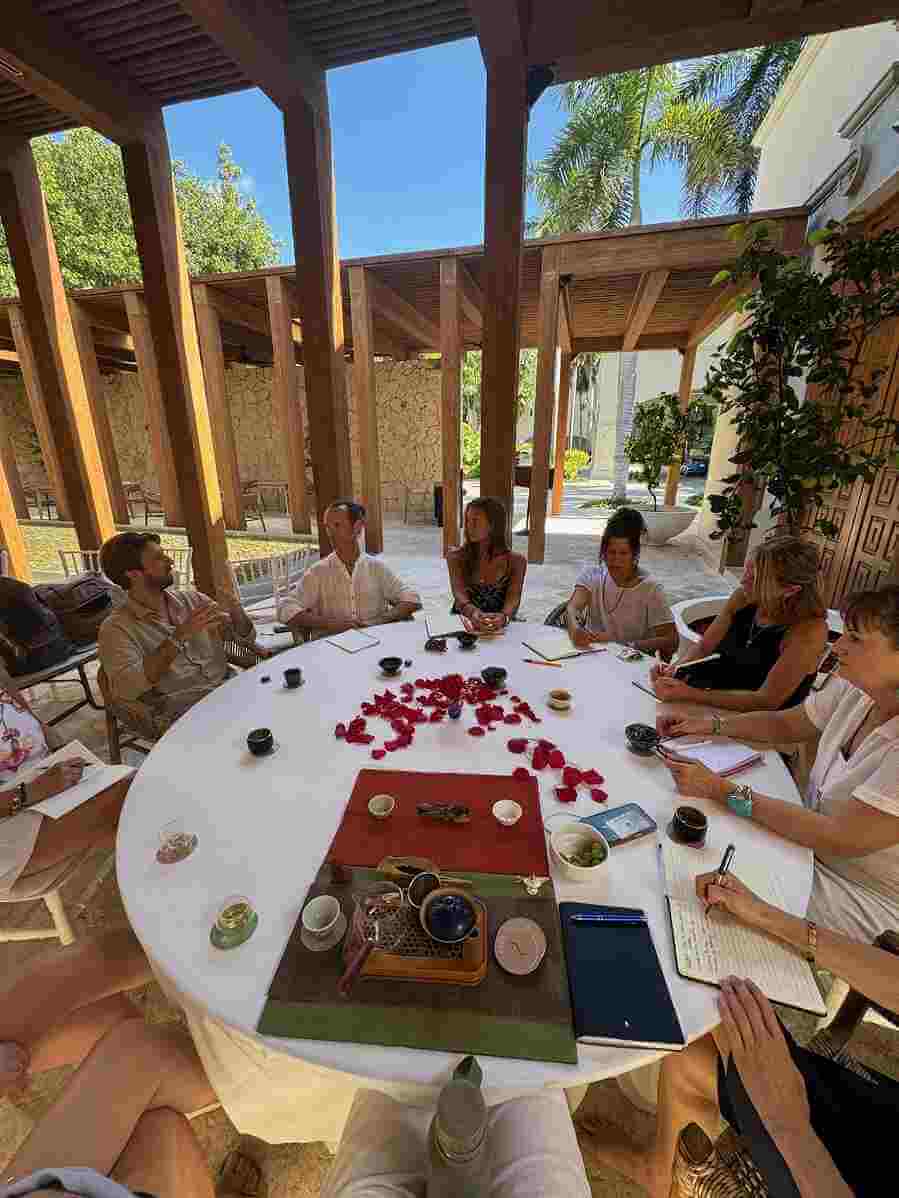
Human connection depends on qualities that are difficult to automate: attention, empathy, timing, trust, humour, intuition, vulnerability, and presence.
These qualities often appear inefficient.
A good conversation may wander away from its original purpose.
Someone may spend an hour talking to a person who never becomes a client.
Friends may meet without producing anything measurable.
A dinner can run longer than planned because nobody wants to leave.
From a purely efficiency-driven perspective, these moments can appear unproductive.
From a human perspective, they may be the entire point.
Bali often creates environments where these moments can still occur naturally. A meeting may continue over lunch. Someone introduced at an event may join another gathering later that week. A work conversation can become a friendship. A neighbour can become part of a support system.
The island does not automatically create meaningful relationships, but it offers many opportunities for them.
Whether people use those opportunities is another matter.
It is possible to live in Bali while spending most of the day behind a laptop, ordering meals online, communicating through messages, and moving between home and work without developing much connection to the people nearby.
Physical location alone does not protect anyone from digital isolation.
Intentionality becomes important.
If technology makes work faster, what happens to the time saved?
Does it become another hour of work?
Or does some of it return to relationships?
This may become one of the defining questions of modern life.
Efficiency has traditionally been treated as an unquestioned benefit. Faster communication, faster travel, faster decisions, faster production. Yet if every saved minute is immediately filled with another task, efficiency never actually gives people more time.
It simply increases capacity.
There may be another way to use it.
AI could help remove repetitive work so people can finish earlier and have dinner with family.
It could help prepare for a meeting so more of the meeting can be spent listening.
It could help identify a person someone promised to reconnect with.
It could translate between languages and make a conversation possible that would otherwise have been difficult.
It could handle information while humans concentrate on relationships.
This is a very different vision from using technology to eliminate interaction altogether.
The choice matters for businesses too.
Hotels, restaurants, event organisers, coworking spaces, communities, and service businesses will increasingly have access to technology that can automate communication and personalise customer experiences.
Some of this will significantly improve service.
But hospitality has always contained something beyond service.
It contains the feeling of being received.
A guest remembers when somebody notices they have returned.
A customer remembers when a conversation continues from the previous visit.
A newcomer remembers the person who introduced them to someone else rather than simply showing them where to sit.
These interactions are small and difficult to scale perfectly.
That may be exactly why they become more valuable.
As automation increases, genuinely human moments become easier to notice.
The same applies professionally. When everyone has access to tools that can create presentations, emails, proposals, research, and content, technical output alone may become less distinctive.
Trust becomes more important.
Reputation becomes more important.
Knowing how to communicate with people becomes more important.
Relationships become more important.
The future of networking may therefore involve more technology, not less, while simultaneously requiring greater human awareness.
Technology can help someone identify whom they have not contacted in six months.

It cannot care about that person for them.
It can suggest the right words.
It cannot create sincerity.
It can remind someone to listen.
It cannot do the listening.
This makes the human role clearer rather than smaller.
Bali is well positioned for this conversation because it already sits between two worlds. It is home to remote workers, technology entrepreneurs, digital businesses, and internationally connected professionals, while also remaining a place where ceremony, family, community, hospitality, nature, and face-to-face relationships continue to shape everyday life.
The challenge is not choosing one world over the other.
It is deciding how they can support one another.
The most useful technology may be the technology that makes people more available to life beyond the technology.
If AI gives someone back an hour, perhaps the most interesting question is not what additional task can fit into that hour.
It may be who they can spend it with.
As technology becomes better at connecting everything around us, are we becoming better at connecting with one another?