




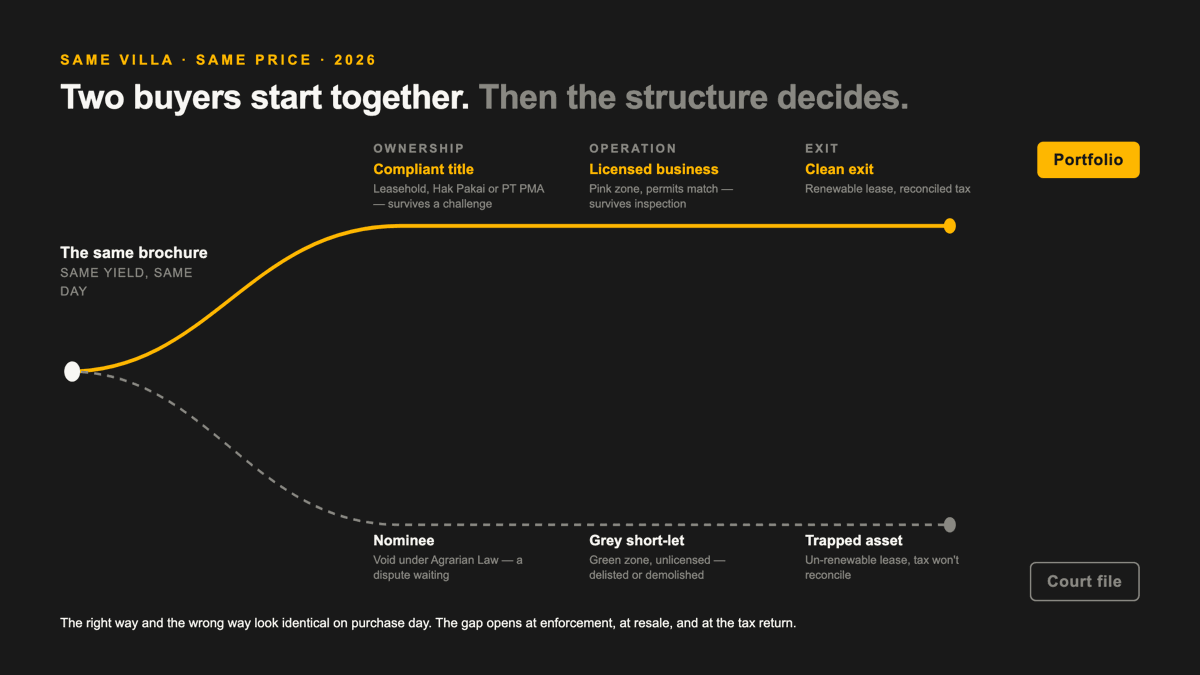
Two buyers paid the same price for the same villa in the same year. Five years on, one holds a growing portfolio and the other holds a court file. Nothing about the purchase day explained the gap. Same location, same builder, the same yield printed on the same brochure. The difference sat entirely in the parts nobody photographs: how the property was owned, how it was operated, and whether it could ever be sold on.
This is the part of Bali investment the get-rich guides never reach. They sell the entry. Wealth is decided at the exit.
Bali drew close to 6.95 million foreign arrivals in 2025, a rise of almost ten per cent on the year before. Demand is real, and the case for owning here is real with it. What has changed is that the market no longer forgives a weak structure. The buyers building genuine wealth and the buyers quietly losing it often start from the same spreadsheet. They diverge at the three moments that spreadsheet never models.
The Number That Actually Builds Wealth
Wealth in Bali property is built on land appreciation captured through a structure that survives, plus rental income kept after tax, minus the losses avoided along the way. That last term is the one the marketing decks delete.
The circulating playbooks quote net yields of ten to fifteen per cent and compound them forward into a million within five years. Those figures are drawn from villa management brochures, not from independent market data, and they assume full occupancy, no vacancy, and no tax drag. The honest picture is narrower. Gross yields across the market sit around the low teens; once realistic operating costs are applied, management fees, platform commissions, staffing, utilities, maintenance and insurance, net returns fall into the single digits before any income tax is charged.
Tax then moves the number again, and it moves it per owner, not per property. A resident holder with a tax number pays a ten per cent final rate on rental income. A non-resident faces twenty per cent withholding on income sent overseas, reducible under a double tax treaty with the correct paperwork. Two buyers, the same villa, different net returns. Anyone who quotes you a single yield figure without asking how you will hold the asset is selling, not advising.
The wealth is genuine. It is simply slower, more conservative, and far more dependent on structure than the headline promises.
Where Ownership Silently Decides the Outcome
The first divergence is the ownership route, and it is the one that looks most identical on day one.
The compliant paths are leasehold, Hak Pakai for qualifying residents, or a foreign-owned company holding the correct title. The grey path is the nominee arrangement, where an Indonesian name holds freehold land on a foreign buyer’s behalf. It is cheaper. It is faster. It is also void under Indonesia’s Agrarian Law, which means the arrangement has no standing the moment it is contested. The buyer who chose it does not own a discounted villa. They own a dispute waiting for a trigger.
This is why the entry price tells you almost nothing. The nominee villa and the leasehold villa can carry the same sticker. Only one of them still belongs to you when a family member of the nominee, a creditor, or a court takes an interest.
Where Operation Meets Enforcement
The second divergence arrives when the villa starts earning, because a rental villa in Bali is now treated as a licensed tourism business, not a private house with a booking calendar.
That means correct business classification, a building permit that matches commercial use, a certificate of proper function, and zoning that actually permits tourism activity. Pink zones allow it. Green agricultural land does not, and no amount of local sign-off changes what happens when national enforcement arrives. The demolitions at Bingin in July 2025 made that distinction physical. Structures that had operated for years came down, because customary approval and national legal compliance are two different systems, and only one of them holds when the bulldozers are dispatched.

Enforcement has since moved from the beach to the platform. The Ministry of Tourism has already identified roughly 1,600 accommodation businesses marketed on the booking sites without the licences they require, and from 1 August 2026 those operators can be removed if they have not regularised during the transition window they were given. A harder backstop follows. An interface linking the platforms directly to the national licensing database is due to be fully operational by July 2027, at which point an unlicensed property can be identified and delisted by the system itself, with no inspector ever visiting. The grey short-let therefore runs on a clock it does not control. Either the income is switched off at the platform, or the structure is exposed on the ground, and the owner does not choose which arrives first. Neither is a footnote in a wealth plan. Both erase it.

The Exit Is Where the Money Is Kept
The third divergence is the one the get-rich guides never mention, because it happens years after their sale has closed. Bali wealth is realised on resale, and resale is where a weak structure finally presents its bill.
A leasehold apartment in a shared building lives or dies on its extension mechanism. The question is not whether one landowner is willing. It is whether the renewal is coordinated across every owner in the structure through a master arrangement that holds. The verified standard is clean: the developer carries the renewal obligation with the landowner, and individual owners extend through the developer. Where that mechanism is absent, a buyer is holding a lease that shortens every year and cannot be independently renewed. It will not command a premium on exit. It may not command a buyer at all.
Tax history decides the rest. With values now cross-referenced automatically through the Coretax system, a paper trail that does not reconcile becomes a problem precisely at the point of sale. The compliant seller also understands what they actually owe, and what they do not. Value added tax on new property from a developer is widely quoted at twelve per cent, yet the effective rate on non-luxury residential property is eleven per cent, with the true twelve reserved for luxury property valued at thirty billion rupiah and above. For 2026 there is also a government-borne relief on the first two billion rupiah of eligible new, ready-to-occupy property valued up to five billion, available to foreign nationals with a valid stay permit where handover falls within the year. The buyer paying twelve per cent on a non-luxury purchase, and missing relief they qualify for, has lost money before they have earned a rupiah of rent.
The Right Way and the Wrong Way Look Identical on Purchase Day
That is the uncomfortable truth beneath every Bali success story and every Bali cautionary tale. On the day of purchase, the two are almost impossible to tell apart. Same villa, same price, same projected return. The gap opens later, at enforcement, at resale, and at the tax return, and by then it is expensive to close.
Building wealth here is not about finding a secret yield or a hidden corridor. It is about buying an asset whose ownership survives a challenge, whose operation survives an inspection, and whose exit survives a valuation. That is unglamorous work. It is also the entire difference between the buyer with a portfolio and the buyer with a court file.
The buyers who get it right tend to have one thing in common. Before they fell in love with a property, they had someone on their side of the table whose only job was to examine what the brochure left out.