




In September 2024, Time Out named Pererenan the third coolest neighbourhood in the world, the highest ranked in Asia, ahead of districts in Seoul, Tokyo and Hong Kong. For a stretch of rice terraces and black sand at the northern edge of the Canggu corridor, it was a remarkable arrival on the global stage. Two years on, the more interesting story is what happened next. Pererenan did not simply become popular. It leapfrogged its own neighbours to become the premium enclave of Bali’s western coastal corridor, and the buyers doing well there in 2026 are the ones who understood the difference before they signed anything.
This is the second instalment in our monthly series examining Bali’s neighbourhoods through verified market data rather than sentiment. Pererenan earns its place because it has changed faster than its reputation has, and the gap between the two is where informed buyers are finding their edge.
Still a Desa, and That Is the Point
Pererenan remains, administratively and in daily life, a desa: a working Balinese village with its own banjar, temple ceremonies that still close the roads, and rice terraces that still get harvested in the northern half of the village. It sits between the Pererenan River and Seseh, technically within Mengwi district rather than Canggu proper, a distinction that matters more on paper than on the ground. The beach is a long run of dramatic black volcanic sand with a reef break that rewards intermediate and advanced surfers, quieter than Echo Beach immediately to the south. Behind it, Jalan Pantai Pererenan has grown into one of the island’s most talked-about dining strips.

The crowd is noticeably different from central Canggu, and it explains a great deal about the market. Pererenan attracts the visitor who has usually done Canggu already: remote workers and entrepreneurs settling in for a month or a season rather than a week, couples and young families choosing villa compounds over party hostels, and a substantial community of long-stay expats who anchor the cafés outside peak hours. Short-stay holidaymakers come for the restaurants and the surf, but the neighbourhood’s character is set by its long-stay population. It is calmer at night than Canggu, genuinely well suited to families, and organised around villas rather than hotels. A village that kept its ceremonies while earning a global dining reputation is a rare thing, and the market has priced accordingly.
The Leapfrog: What the Prices Now Say
The most persistent belief about Pererenan is that it remains the affordable back door into the Canggu corridor, a place still catching up to its more established neighbour. The smartest buyers stopped thinking that way some time ago, and the data explains why.
According to REID, Bali’s independent property intelligence platform and our market data partner, the median asking price across Pererenan villas now stands at USD 340,000. That single figure understates how the market actually behaves, because price moves in a clear staircase with bedroom count. A one-bedroom villa carries a median price of USD 160,000, a two-bedroom USD 249,000, a three-bedroom USD 394,000, a four-bedroom USD 730,000, a five-bedroom just over USD 1 million, and a six-bedroom USD 1.26 million. Rather than a village quietly catching up to Canggu, this is a market that has already priced itself as a premium address across every size of property in it.

Read positively, this is exactly what leapfrogging looks like. Villages do not command a seven-figure median at the top end by accident. They command it because demand is deep enough to support it at every price point, and the buyer profile has matured alongside the place. The mistake is not buying Pererenan at premium prices. The mistake is buying it while still negotiating as though a discount exists somewhere in the corridor.
The Squeezed Middle: Where Yield Actually Sits
Commentary currently circulating tends to treat Pererenan yields as a single, flat figure. The real pattern, once verified against REID’s villa-only data, is a great deal more interesting, and it rewards buyers who look past the headline.
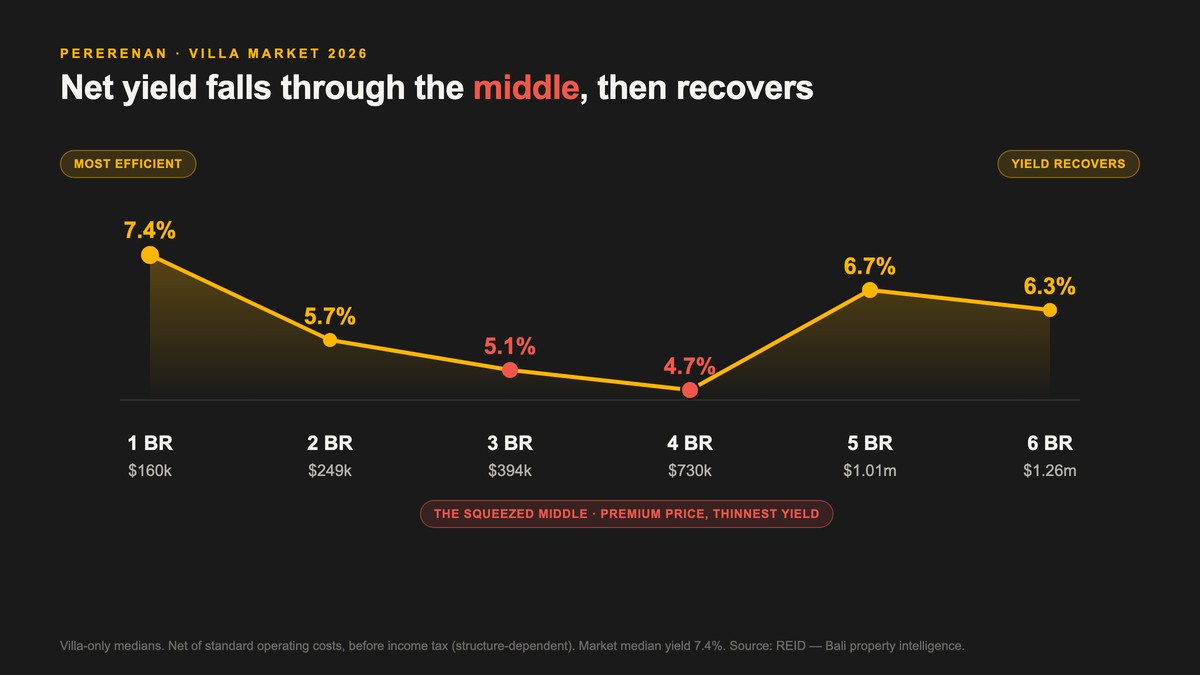
Net yield does not fall evenly as villas get larger. It falls through the middle of the market and then recovers at the top. A one-bedroom villa nets approximately 7.4% on its USD 160,000 median price, generating roughly USD 11,900 in annual net revenue. Move up to a two-bedroom and yield drops to 5.7%. A three-bedroom nets 5.1%, and a four-bedroom compresses further still to 4.7%, even as the annual net revenue climbs to around USD 34,700. Then, at the top of the market, yield recovers: a five-bedroom villa nets 6.7% and a six-bedroom nets 6.3%, on annual net revenue north of USD 70,000.
The middle of the market, three and four bedrooms, is where price has run furthest ahead of achievable rental income, and where buyers pay the premium enclave price without the yield to match. The smallest entry point and the largest luxury villas are where the market currently rewards capital most efficiently, at 7.4% and in the mid 6% range respectively, against a market-wide median of 7.4%. All figures are net of REID’s standard operating cost assumption and before income tax, which is structure-dependent: an Indonesian tax resident, a KITAS holder and a non-resident buyer will each see a different final outcome from the same villa.
The Property Now Matters More Than the Postcode
One thing sits above everything else in this article, and it is the most valuable sentence in it for a first-time buyer. Every figure here is a median for its segment. The staircase in prices from USD 160,000 to over USD 1.2 million, and the swing in yield from 4.7% to 7.4% depending on bedroom count alone, shows just how much a buyer’s outcome depends on where in that staircase they choose to stand. Two villas of different sizes on the same street can sit on completely different sides of this pattern, before build quality, management and lease documentation are even considered.
That is what graduation looks like in a property market. Pererenan in 2026 still delivers everything that earned the world’s attention: the surf, the rice terraces, the ceremonies, the best new dining strip on the island. What has changed is that the neighbourhood no longer does the investment work for you. Bedroom count, segment positioning, build quality and management now determine the outcome far more than the address does, which is exactly how mature markets behave everywhere in the world.
For the buyer who does the verification, that is not a warning. It is an advantage, because most of the market still has not caught up. If you are considering Pererenan and would like the independent numbers on any property you have been shown, measured against the same standard used in this article, you are welcome to reach out or leave a comment below.
Market data in this article is provided by REID, Bali’s independent property intelligence platform and Fullers Properties’ market data partner, based on villa-only median price and net yield figures for Pererenan. Individual property performance varies with location, build quality, management and lease terms. Source: realinfo.id (https://www.realinfo.id/).