




Negligence is omnipresent in Bali. The concept, however, is almost unknown. I have never once heard an Indonesian casually use the word for it — kelalaian. That alone says quite a lot. Things are constantly being “left” undone that, upon closer inspection, should not be left undone at all.
Gas cylinders without proper seals.
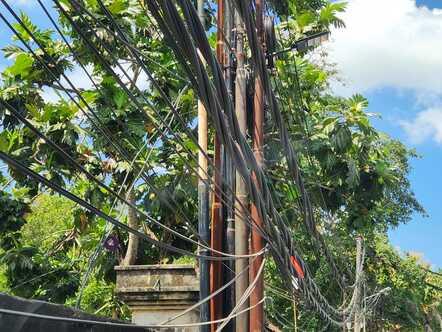
Overloaded trucks with crooked, rotting wooden sideboards. Electrical cables drooping lazily over the street. Motorbikes without lights. Cars driving at night with only one functioning headlamp — so that until the very last second you believe a motorcycle is approaching, only to realize it is an entire car occupying your lane.
In other parts of the world — say, Europe — the word negligence appears everywhere. Complaints of negligence. Accusations of negligence. Escalations to gross negligence, which may end in courtrooms and occasionally in prison cells. You encounter it in schools, in traffic law, in hospitals, in parenting manuals, in recreational activities — mountain hiking, kayaking, swimming in lakes.
There is an almost sacred expectation that somewhere, at all times, a responsible authority must stand ready. A guardian. A supervisor. A first responder. Someone whose duty it is to foresee danger before it unfolds.
And if that exhausting vigilance fails — if someone neglects to anticipate what might go wrong — there will be a plaintiff. Failure to assist. Failure to prevent. Failure to foresee. There are complaints about negligent teachers, negligent drivers, negligent doctors, negligent parents, negligent municipalities, negligent dog owners.
The underlying assumption is clear:
Someone is responsible. And if something goes wrong, that someone must be located. Recently, in Austria, a young man was arrested after leaving his exhausted girlfriend high on the Großglockner (the highest mountain in Austria) to run down the mountain and fetch help.
She did not survive the night. When rescuers returned, she was already dead.He, meanwhile, had transitioned from desperate partner to negligent killer.
I suspect I will hike alone next time. It seems safer legally.
In Bali, matters unfold differently. If an electrical cable falls onto your head, it is unfortunate. If you break your leg because a manhole cover is missing from the sidewalk — the same sidewalk you chose because you believed it to be safer than the road — it is regrettable.
If you disappear waist-deep into an unlit drainage canal while walking home at night, it is, technically speaking, an accident.
There will be sympathy. There may even be mild embarrassment. There will not be a lawsuit. There are victims in Bali. There are no plaintiffs.

Accidents caused by someone else’s carelessness are rarely framed as someone else’s fault. They are absorbed into a broader cosmology. Bad luck. Bad Timing. Bad Karma. Responsibility dissolves gently into metaphysics.
If you look closely, these are rarely acts of malice. They are not carefully planned disasters. They are products of improvisation, indifference, absence of training and a workplace culture where “good enough” is often good enough indeed.
Education levels vary widely. Formal training is frequently minimal. Work is approached with a kind of relaxed fatalism. Something is temporarily tied down — even though it is obvious that at the next sharp curve, or under firm braking, the entire load will slide.
The electrician — who calls himself one because he twists cables together and owns pliers— may have no idea about voltage, load capacity, or why speaker wire should not power an air
conditioner.
Old car tires are patched until the steel mesh protrudes visibly through the rubber. Drainpipes are repurposed as gutters, sagging slowly until one day they detach and fall on someone’s head.
When my laptop was returned from repair, it contained only three screws instead of the original twelve. After all, the cover still held. Why invest the effort to locate the remaining nine? Three would do.
You see it in construction sites where electrical wiring snakes dangerously close to wooden beams and dry grass shingles. In plumbing systems clogged with leftover building debris that guarantee future flooding. In scaffolding assembled with optimistic faith rather than structural calculation.
Improvisation is the dominant engineering philosophy.
When my laptop returned from repair, it contained three screws instead of twelve. The cover remained attached. Why pursue perfection when sufficiency is available? And then there are the trucks.
Ancient beasts of metal and willpower, traveling endlessly between Java and Bali, overloaded beyond optimism. Rusted chassis. Maroded wooden sideboards. Leaf-spring suspensions creaking like colonial ships. Brakes whistling their objections. Diesel smoke trailing behind like a visible confession. By European standards, many of these vehicles should have retired before COVIT.
Instead, they endure.
Which reveals the paradox at the heart of it all.
In societies obsessed with preventing negligence, systems become rigid. Responsibility is institutionalized. Risk is minimized through regulation, litigation, and documentation. In Bali, risk is normalized. Responsibility is diffused. Systems remain fragile — but remarkably resilient.
Things survive not because they are maintained properly, but because they are endlessly tolerated. People adjust. They step around open drains. They drive defensively. They expect improvisation.
Life here does not eliminate danger.
It absorbs it.
This is neither condemnation nor romanticizing. It is structural reality. For the holiday visitor, this dynamic is visible, but the island glows with ceremonies. The smiles are genuine. The sunsets spectacular. You are insulated by temporariness.
As a resident who must depend on infrastructure, contracts, and sustained reliability, you enter a different negotiation — one where the absence of negligence as a concept becomes profoundly tangible.
In Bali, responsibility is collective. Accountability is optional. And endurance, somehow, prevails. It is a place where systems creak, cables sag, trucks groan — and yet everything keeps moving.
Not safely.
But persistently.