


A groundbreaking ceremony in Bali is rarely just a ceremony. At the site of Zenergy, a 131-residence wellness community taking shape on Candidasa’s coast, the founders knelt alongside villagers and local law enforcement for a traditional blessing before a single brick was laid. Fullers Properties was one of a small number of Bali real estate agencies invited to witness it. What stood out was not the scale of what is being built, but the order in which it was done: the blessing came first, and everything else follows from it.
A Coastline That Has Been Here Before
Candidasa was Bali’s first real answer to Kuta. Tourism arrived here in the 1970s, decades before Canggu existed as a destination and long before Uluwatu’s clifftop villas were more than rice terraces and cattle tracks. It had its moment, faded quietly as the island’s attention moved south and west, and has spent the years since as one of Bali’s more overlooked corners: beautiful, unhurried, and largely left alone. That is precisely the setting Zenergy’s founders chose, and the choice was deliberate. A place that has watched tourism come and go before is not a blank canvas. It is a community with its own memory of what development can mean, for better and worse.
A Blessing as the Starting Point, Not a Formality
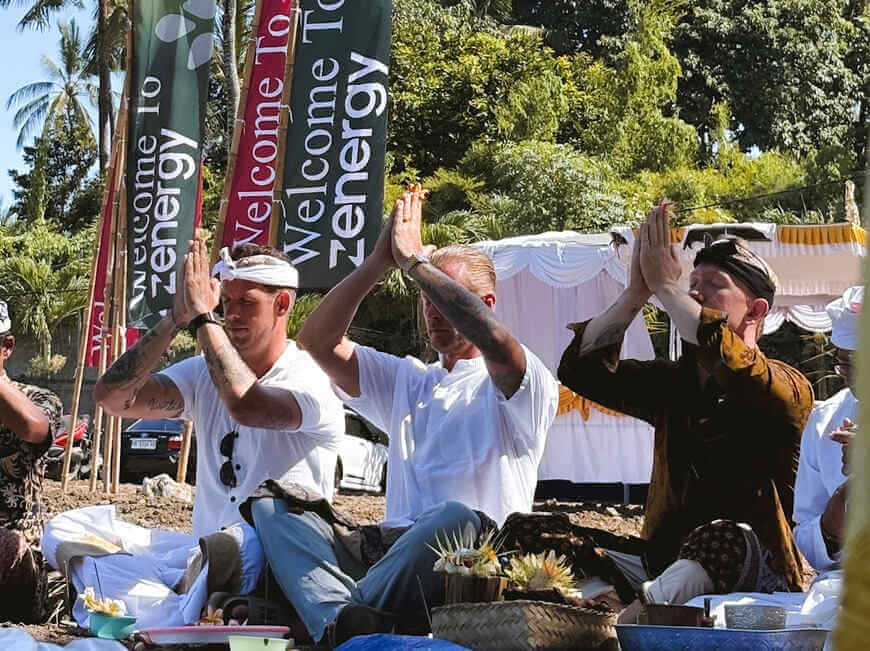

For Lukas Seerup Nielsen, CEO and co-founder of Zenergy, the ceremony was the whole point. Speaking at the site, he was direct about the thinking behind it: as foreign founders arriving in Bali, the responsibility was to learn from the island rather than simply build on it. Coming to Bali as a guest, he said, means coming to give rather than to take. The blessing was one part gratitude and one part accountability, a public acknowledgement that the land, the spirits, and the community’s support all mattered more than the architecture that would eventually stand on it.
That instinct sits close to the Balinese philosophical concept of Tri Hita Karana, the idea that wellbeing depends on harmony across three relationships: between people, between people and nature, and between people and the divine. It is not a concept many international developments engage with beyond a marketing mention. At Zenergy, it appears to have shaped the sequence of events itself, starting with a ceremony rather than an announcement.
Building Alongside the Community, Not Around It
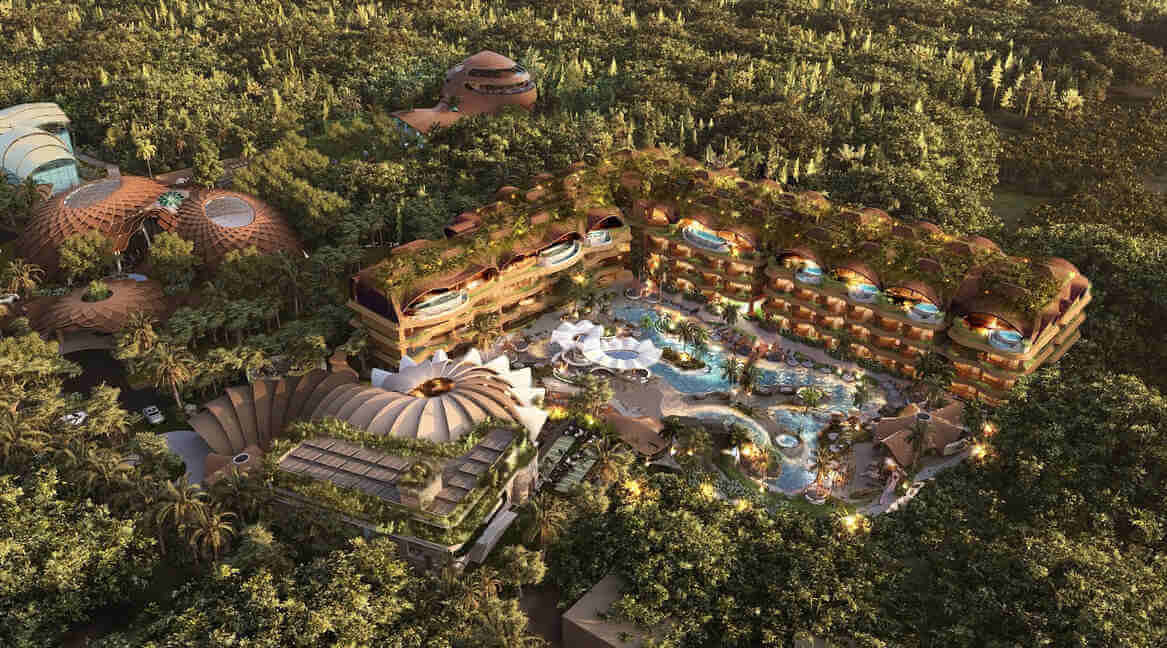
Seerup Nielsen has spoken about the project’s ambition to create employment, training, and partnership opportunities for Candidasa’s community as construction and, later, operations get under way, positioning local involvement as a structural part of the project rather than an afterthought. The clearest expression of that intent so far is Educate Bali, a charity the founders support that teaches English in schools around Candidasa, one of the less resourced parts of the island relative to the south. Every stay at Zenergy is intended to support it directly, tying the commercial life of the project to a form of giving back that continues well beyond the ceremony itself.
A Wider Shift Toward Wellness as an Asset Class
Zenergy is entering a category that has moved from niche to mainstream faster than almost any other part of global real estate. The Global Wellness Institute tracked the global wellness real estate market expanding from 151 billion US dollars in 2017 to 876 billion in 2025, with growth projected to reach 1.8 trillion by 2030, a pace the Institute describes as by far the fastest of any wellness sector it tracks, within a broader global wellness economy that reached 6.8 trillion dollars in 2024. Asia has become the centre of that growth rather than a follower of it. The region’s wellness market reached 2 trillion dollars for the first time in 2024, expanding 9.3 percent that year, and Asia’s wellness tourism sector alone grew 31 percent in 2024, the year it overtook Europe for the largest number of wellness trips recorded. Established names such as Bali’s own COMO Shambhala Estate already sit inside that category, alongside Thailand’s Kamalaya and India’s Ananda in the Himalayas, proof that the region’s wellness hospitality brands can lead the category rather than simply host it. For buyers and investors weighing where to place long-term capital, that is the backdrop against which a project like Zenergy is worth reading: not as a villa development with a gym attached, but as an early entry into one of the fastest-expanding categories in real estate, in the region now driving much of its growth.
Longevity, Built on Bali’s Own Terms
Zenergy positions itself as a living ecosystem rather than a residential development: sports and recovery facilities, co-working space, a kindergarten, and wellness diagnostics, all built around the idea that longevity is as much about community and purpose as it is about biology. It is a fitting philosophy for where it is being built. Balinese life has long organised itself around connection, movement, nature, and spirituality as inseparable parts of the same whole, rather than as separate categories to be optimised individually. Seerup Nielsen described the ambition in a single sentence during the interview: Candidasa becoming the best place on the planet for longevity, built on Balinese values rather than imported ones.
Whether that ambition is realised will take years to judge. What was on display at the groundbreaking was a choice about how to begin: with a blessing, with the community, and with an explicit intention to build with Bali rather than simply in it. Buyers and early investors curious about the project can contact Fullers Properties directly for further information.