




The most expensive number in Bali real estate is the one printed on the brochure. A projection of 20 or 25% returns has sold more villas on this island than any ocean view ever has, and for most buyers it quietly sets an expectation the property was never built to meet. The figure is not always dishonest. More often it is simply the wrong number wearing the costume of the right one.
Gross, Net, and the Word in Between

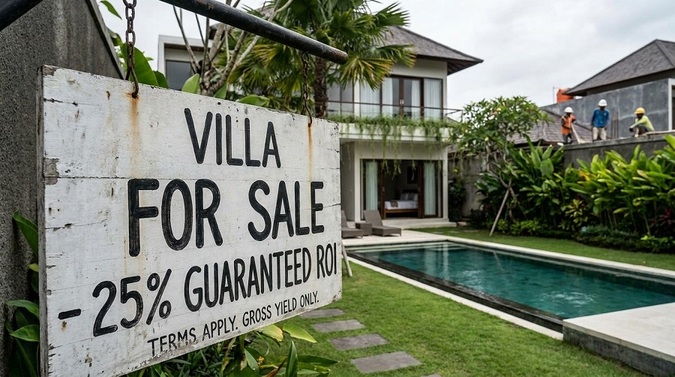
Three terms get used as though they are interchangeable. They are not. Gross yield is annual rental revenue divided by purchase price, before a single cost is paid. Net yield is what survives once the villa is actually run. Return on investment is the full picture, income plus what the asset is worth the day you leave it. A developer quoting 20 to 25% is almost always quoting gross, and frequently a gross resting on optimistic occupancy.
The gap between the first number and the second is wide. REID, the island’s only independent property data platform, models net yield by applying a 50% operating cost assumption to gross, which is the realistic load once management, platform commissions, staff, utilities, maintenance and supplies are all counted. On that basis its market-wide reading for 2025 was a gross yield of 12.3% and a net yield of 6.1%. Terje Nilsen of Seven Stones put it more plainly in his own analysis: the island is full of projected 20% decks, a few are achievable, and most are not.
The Yield You Keep
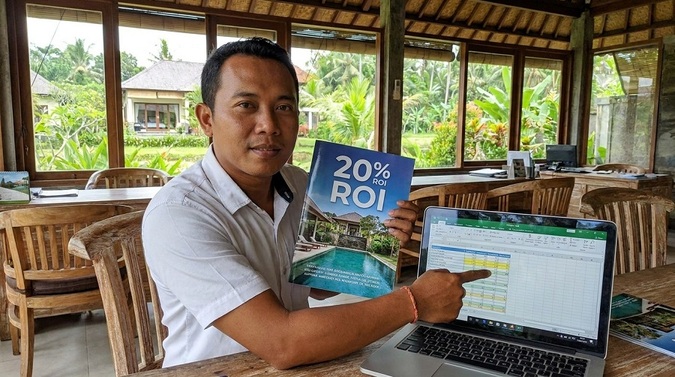
To see where the money actually goes, look at a villa that trades rather than a villa that is pitched. A two-bedroom in the Bukit that we recently reviewed for a client arrived with a full year of audited statements instead of a seller’s estimate. The headline owner return read close to 16%. Put through our standard buyer-side stress test, the same 50% cost floor REID applies, it settled near 11%. Both figures are real. One describes a flawless year, the other a normal one, and the honest number to underwrite against is the lower of the two.
The costs that close that gap are not exotic. On one verified property, booking-platform commissions alone ran close to 20% of gross, and after everything was paid the owner kept a little over two thirds of every rupiah the villa earned. That is a well-run asset, not a failing one. It is simply what operating a short-stay rental costs in a high-service tropical market.
One more distinction separates a number you can trust from one you cannot. A maintenance reserve, usually around 1% of the purchase price each year, and the periodic renewal of a building’s operating certificate are not operating expenses. They are capital you set aside, money you still hold. They should never be deducted from yield, yet sellers routinely ignore them and cautious buyers routinely double-count them. Knowing exactly where each cost belongs is the whole discipline.
The Line Nobody Prints: Tax

Here is the figure almost no advertised yield includes: income tax. REID leaves it out deliberately, and so do most honest models, because tax is not a fact about the property. It is a fact about the owner. A resident holder with a local tax number pays a 10% final rate on rental income. A non-resident pays 20% withholding, unless a double-tax treaty with their home country reduces it through the correct filing. A buyer holding the villa inside a foreign-owned company is taxed differently again, as corporate income.
The consequence is striking. Two people can buy the same villa, earn the same rent, and keep materially different amounts, purely because of how each structured the purchase—which is why buying from a company that specialises in investment villas can make a real difference. On one property we modelled, a normalised net return sat above 10% on the owner-record method, but once the 10% rental tax and modest village fees were applied, the conservative figure came to 9.7%. Same villa, different outcome. The point is not that tax ruins the return. It is that your return is decided in a lawyer’s office as much as on a booking platform, and any ROI quoted without reference to your structure is incomplete by definition.
How Bali Compares, Honestly
This is where Bali earns its reputation, as long as you compare like with like. A recent client of ours was moving capital out of Dubai, a market that rewards investors with gross yields of 6 to 8% and roughly 5 to 7% net, helped considerably by zero tax on rental income. Strong figures. Yet Bali’s market-wide net of around 6% matches them, and a well-chosen, well-run villa here comfortably clears them. Set against the cities most international buyers know best, the distance widens: London sits at 3 to 4%, New York at 4 to 5%, Sydney at 3 to 4%, and Singapore and Hong Kong nearer 2 to 3%, most of those gross figures that shrink further once costs are paid.
Honesty about the caveats is what makes the comparison credible. Most Bali villas are held on leasehold, and a lease is a depreciating asset, so part of any headline yield is really the return of your own capital across the life of the term. Returns here also demand active operation rather than the passive collection of an annual tenancy. And the structure question runs through all of it. Account for those three things and the conclusion still holds: on income alone, Bali remains one of the highest-yielding property markets in the world.
Tighter Rules, Record Crowds
None of this is being undone by regulation, whatever the headlines suggest. 2025 was a record year, with close to 6.95 million foreign arrivals, a rise of almost 10%, alongside more than 26 million domestic trips. Early 2026 has held those levels. Demand is not softening. The rules are catching up with the supply, and that distinction matters enormously to a buyer.
It means the first question about any villa is no longer its view, its design or even its nightly rate. It is whether the asset is clean: correctly zoned, properly licensed, the building permit and operating certificate in order, the lease verified. A non-compliant villa is fast becoming an unsellable one, and a villa you cannot sell has no exit, which means no true ROI no matter what it earns each month. Compliance is now the first filter, ahead of location and ahead of beauty. It is the reason we verify the trading data, the legal stack and the ownership structure of every property before it reaches a client or our buyer network. A yield only counts if you can keep it and one day sell it.
Where the Real Money Looks
Which brings us to the part most buyers never reach. A single villa’s net yield is where the conversation usually stops. For the people quietly building real wealth here it is barely where it begins, because the serious returns in Bali have surprisingly little to do with one property’s nightly rate. This market does not reward capital the way London or Sydney does, and the buyers who understand that difference are playing an entirely different game.
That game, and the structures behind it, is where we are going next.